
Don’t Swipe Right on Scams: Why Fraudsters Love Singles Day
Singles Day is supposed to be a day for treating yourself. For scammers, it is a day for finding the people who feel the most alone.
Tomorrow is 11.11, Singles Day. It started in the 1990s as a joke among university students in China (four ones, four singles, at least that's how I understand it 😜), and then certain large online retailers noticed and turned it commercial. Here in Iceland we do have sort of an "adopted holiday", and I have already written about fake deals and cloned stores, so I will spare you the shopping life lessons.
This year I want to talk about the other half of the name. The single half.
Scammers love holidays. They love emotional holidays even more. And their absolute favorite is an emotional holiday that lands on someone who is already in a vulnerable place. For some people, a day built around being single is a fun excuse to buy themselves something nice. For others, it is a reminder that the house is quiet, that the divorce was finalized in the spring, or that the person they shared forty years with is not there anymore.
Why lonely is the target
I work on the defense side of cybersecurity, and one thing you learn quickly is that attackers go where the defenses are weakest. With computers, that might be an unpatched server. With people, it is usually an emotional need, especially strong ones like fear, greed, and, I wish it were not so, loneliness.
Loneliness is not a flaw in someone’s character. It is a human thing, and plenty of smart & careful people feel it. But it does change how we judge risk. When someone finally pays attention to you, asks how your day went, remembers your dog’s name, and seems genuinely happy to hear from you, the part of your brain that would normally ask “wait, who is this person?” gets a lot quieter.
That is exactly what a romance scammer is selling: attention. Patient, kind, consistent attention. The only thing fake about it is the person.
How it plays out
Romance scams are rarely fast, and that is exactly why they work. A typical one looks something like this:
- The match. A message on a dating app, a friend request on Facebook, or a “wrong number” text that turns into a friendly chat. The profile is attractive but believable, usually with a job that explains being far away (offshore oil rig, military deployment, doctor with an aid organization, engineer on a project abroad).
- The move. Within days they want to leave the dating app for WhatsApp, Telegram, or regular texts. They will say it is more private. It is, for them, because the dating platform can no longer see the conversation or ban their account.
- The bond. Weeks or months of daily messages. Good mornings, good nights, photos, plans for when you finally meet. This is their investment phase, and they are patient because the payout is large.
- The ask. And then something happens. A medical emergency, a customs fee on a package, a plane ticket so they can finally come visit, a frozen bank account that only needs a little help.
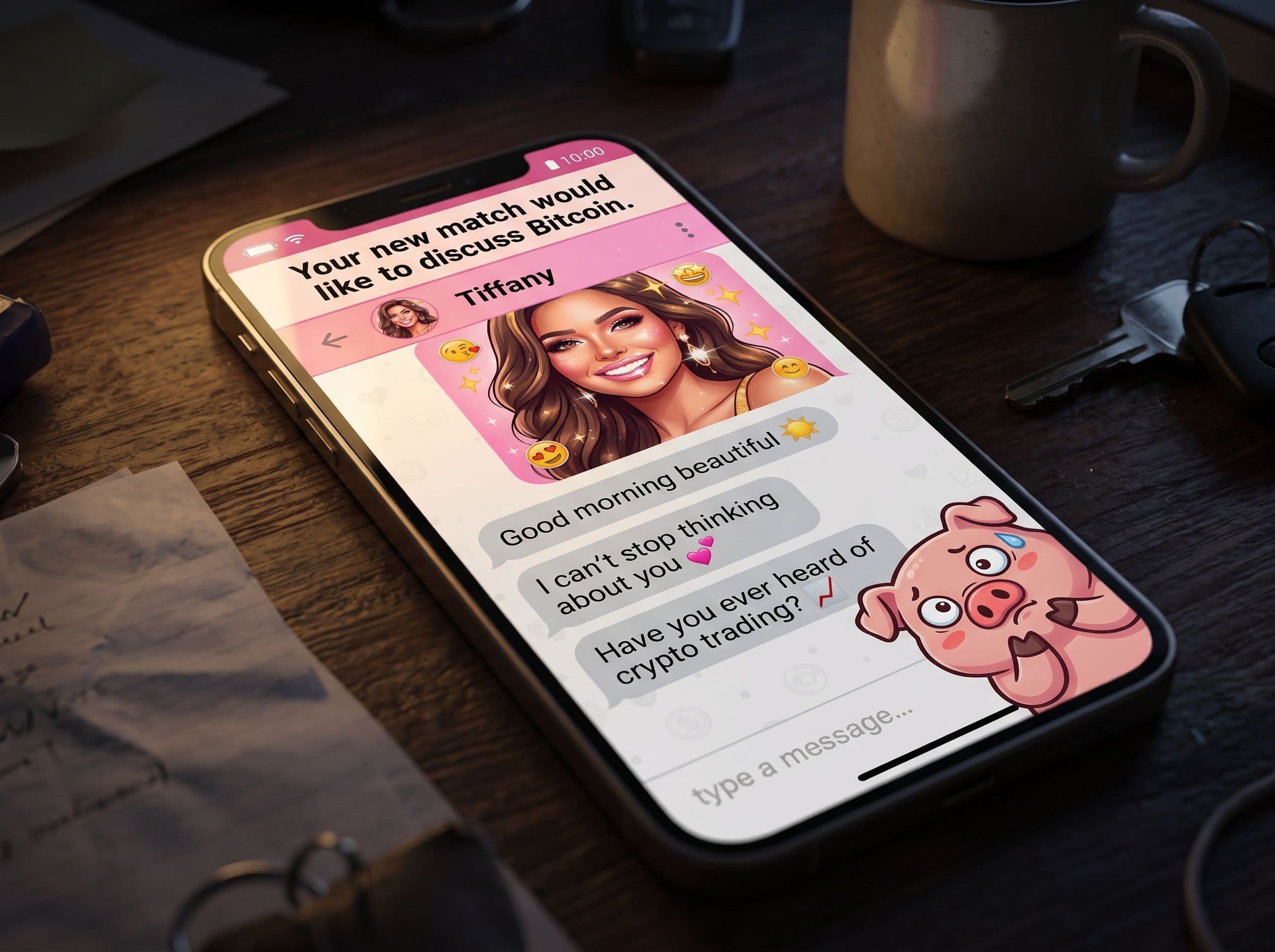
There is also a newer variation called “pig butchering” (because they “fatten up” the victim first). Here the ask is not for help. It is an opportunity. Your new partner happens to be very good at crypto trading and would love to show you how. You start small, the trading platform shows great returns, so you put in more. The platform is fake, the returns are fake, and when you try to withdraw, there are suddenly “fees” and “taxes” to pay first or it all just disapears. People lose their savings or pensions, and sometimes they get so deep even their homes.
Habits of a little mistrust, romance edition
You do not need to stop dating online, and you do not need to treat every kind message like an attack. But a few habits go a long way:
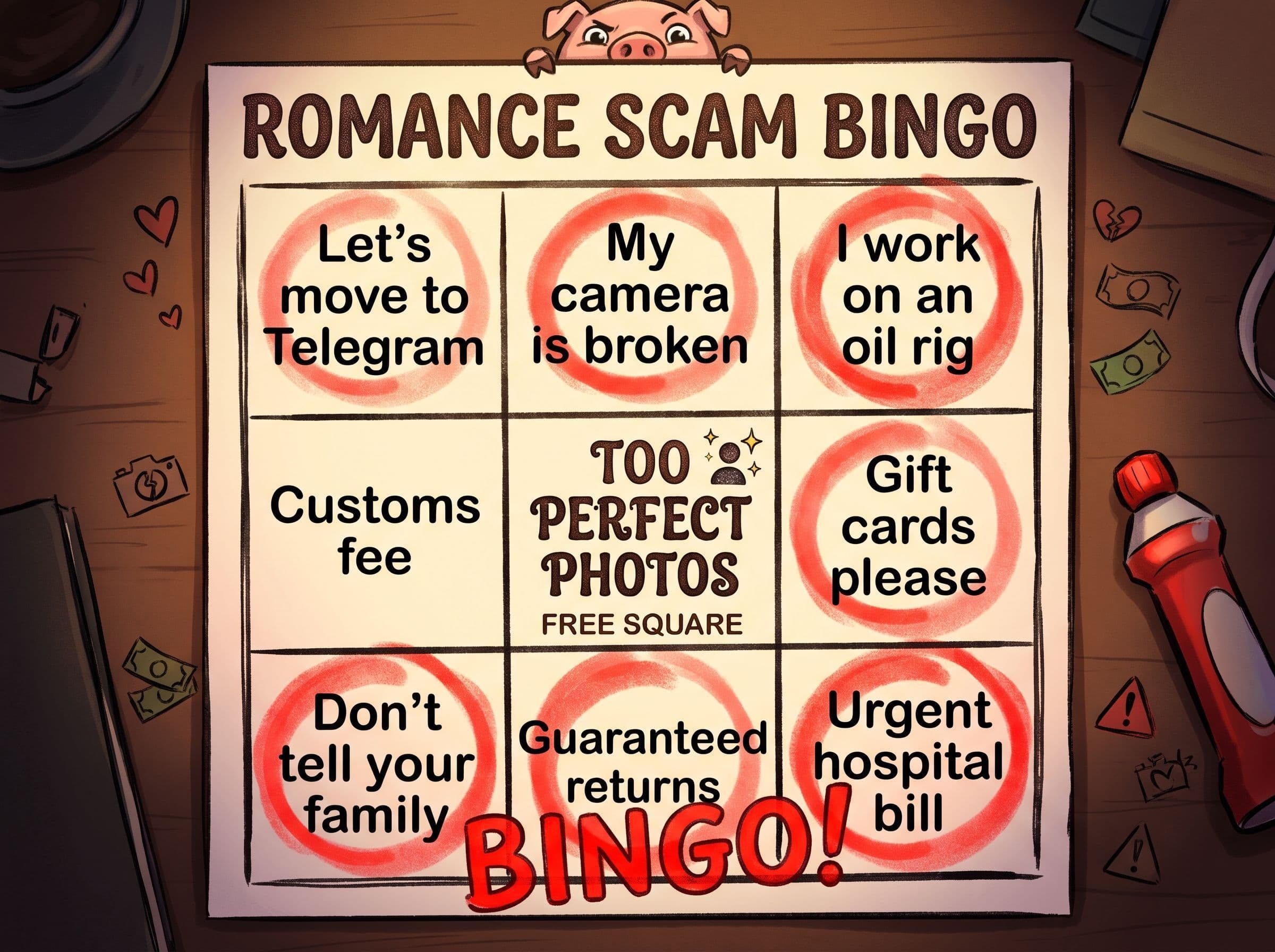
- They want to leave the app quickly. Moving the chat to WhatsApp or Telegram in the first few days is one of the most common early signs. “This app is so glitchy, let’s talk on Telegram instead 😊”
- They can never video call. The camera is always broken, the connection is bad, or calls are not allowed where they work. Almost everyone can video call today. And with AI, even a video call is not perfect proof anymore, so be suspicious of calls that are always very short, blurry, or strangely frozen.
- The photos are a little too perfect. Try a reverse image search with Google Lens or TinEye. If those photos belong to a fitness model in another country with a different name, you have your answer.
- They ask for money, gift cards, or crypto. Any amount, for any reason. This is the line. Someone you have never met in person should not be asking you for money.
- There is always urgency. The hospital needs the payment today, the investment window closes tonight. Pressure is a tool to stop you from thinking, or from asking someone else.
- They ask you to keep it secret. “Your family wouldn’t understand what we have.” That sentence is not romantic. It is isolation, and isolation is how scams survive.
Look out for each other
One final thought. Most romance scam victims are not caught by some clever technical trick. They are caught because nobody around them knew what was happening, and the scammer worked hard to keep it that way.
So this Singles Day, check in on people. The friend who went through a breakup this year. The uncle who has been on his own since his wife passed. A parent, who may be newer to dating apps than they let on. Not to lecture, just to talk. Ask who they have been chatting with lately. Be curious, not judgmental.
And if you find out someone is caught in one of these, please be kind. Victims often feel deep shame, and scammers count on that shame to keep them quiet (sometimes they even come back for a second round, posing as “recovery services” that promise to get the money back for a fee). Shame keeps people from reporting. Kindness gets them help.
If it has already happened, to you or someone you know:
- Stop sending money, no matter what new reason is offered.
- Contact your bank right away. The sooner they know, the better the chance of stopping or recovering a transfer.
- Report it to the police and let CERT-IS know at cert.is.
- Save everything: messages, profile names, and transaction records. Do not delete the conversation, even though you might want to.
- Be wary of anyone offering to recover the money for a fee. That is usually the same scam, round two.
Being single is not a problem, but being lonely enough to ignore a bunch of red flags is. So keep your wits, verify, and be kind, and of course I wish each of you, single or not, a happy Singles Day. Go ahead and treat yourself to something nice from a store you trust, and maybe call someone you have not heard from in a while.
Love wisely friends,

Aaron Galbraith, SecureIT.is - Senior Cybersecurity Consultant
I have worked in IT for over 25 years. I eventually decided I love protecting stuff just a little bit more than I love fixing stuff. I write articles for SecureIT.is to help regular folk, and tired IT folk, make sense of cybersecurity.
We do Security Awareness Training like these articles. Contact us for more information.